As the seventh lunar month arrives, the air across Malaysia carries the unmistakable scent of burning incense, the sounds of getai performances, and the warm glow of paper offerings being set alight. For many Malaysian Chinese families, this marks the beginning of Ghost Month (鬼月, Gui Yue), one of the most spiritually significant periods in the Chinese calendar.
At the heart of these observances is the Hungry Ghost Festival (中元节, Zhongyuan Jie), marked most intensely on the fifteenth day of the seventh lunar month. Rooted in Taoist, Buddhist, and Chinese folk beliefs, Hungry Ghost Festival, also known as Phor Thor (普渡) in Hokkien and Yu Lan (盂蘭) in Mandarin, is dedicated to honouring ancestors, praying for departed souls, and showing compassion towards wandering spirits who have no family to remember them.
Across Malaysia, familiar scenes of roadside altars, burning joss paper, Chinese opera performances, and lively getai stages become part of the cultural landscape. For many, the festival is deeply personal: a time to remember loved ones who have passed and to uphold traditions that have connected generations for centuries.
Key Takeaways
- The Hungry Ghost Festival is observed during the seventh lunar month and reaches its peak on the fifteenth day, known as Ghost Day.
- The festival is rooted in Taoist, Buddhist, and Chinese folk traditions.
- Its main purpose is to honour ancestors and appease wandering spirits.
- Popular Malaysian customs include burning joss paper, preparing food offerings, and hosting Chinese opera and getai performances.
- Ghost Month is also associated with various taboos and superstitions that many families continue to observe today.
- The festival remains an important expression of filial piety and Chinese cultural heritage in Malaysia.
Why Is the Hungry Ghost Festival Celebrated?
According to Chinese folk religion, which blends Taoist, Buddhist, and traditional animist elements, the spirit world operates on a calendar not unlike our own. For most of the year, the gates of the underworld are closed, keeping the spirits of the dead in their own realm.
During the seventh lunar month, however, those gates are thrown open. All spirits, including ancestors who are regularly venerated, as well as lonely or forgotten souls who have no family to remember them, are free to wander the world of the living.
The festival exists for two interconnected reasons: to honour beloved ancestors, and to appease wandering spirits who might otherwise cause misfortune for the living.
The Origins: Taoist and Buddhist Roots
The Hungry Ghost Festival traces its origins to ancient China and draws influence from both Taoism and Buddhism, with elements of Chinese folk beliefs woven into the traditions observed today.
Taoist Beliefs
In Taoism, the seventh lunar month is governed by Di Guan (地官), the Earth Official, who assesses the merits and sins of all living beings on the fifteenth day, the same day the gates of the underworld are believed to open. Throughout the month, community temples hold ceremonies and engage Taoist priests to perform rites, appease wandering spirits, and guide restless souls back to the underworld when Ghost Month draws to a close.
Many of these beliefs surrounding the afterlife, ancestor veneration, and prayers for departed souls continue to influence Taoist funeral practices observed by Chinese families in Malaysia today.
Buddhist Tradition
Buddhist teachings associate the festival with the Ullambana Sutra and the story of Mu Lian (Maudgalyayana), a devoted disciple who discovered that his mother was suffering in the realm of hungry ghosts.
Acting on the Buddha’s guidance, he made offerings to the monastic community on the fifteenth day of the seventh month, generating enough merit to release his mother from her suffering. This act of filial devotion gave rise to the Buddhist observance of Ullambana (盂蘭盆節), making merit on behalf of loved ones who may be suffering in the afterlife.
The Evolution of the Festival
Over the centuries, Taoist and Buddhist practices became intertwined with Chinese folk traditions. As a result, the modern Hungry Ghost Festival is not tied to a single religion. Still, it represents a blend of spiritual beliefs centred on ancestor veneration, compassion for wandering spirits, and maintaining harmony between the living and the dead.
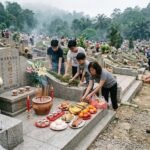
Together with traditions such as the Qingming Festival, the Hungry Ghost Festival highlights the enduring importance of ancestor worship and filial piety in Chinese culture.
When Is the Hungry Ghost Festival in Malaysia?
The Hungry Ghost Festival does not fall on a fixed date in the Gregorian calendar because it follows the Chinese lunar calendar.
Ghost Month begins on the first day of the seventh lunar month and lasts until the end of the month. Throughout this period, families observe various customs, rituals, and taboos associated with wandering spirits.
The Hungry Ghost Festival itself falls on the fifteenth day of the seventh lunar month, often referred to as Ghost Day, and marks the peak of the month-long observance.
The first day (when the gates open), the fifteenth day (the peak), and the final day (when the gates close) are considered especially significant.
Ghost Month Traditions and Rituals in Malaysia
In Malaysian-Chinese society, this period is dedicated to honouring departed souls, not only their ancestors but also those referred to as ‘Good Brothers’ (好兄弟, Hao Xiong Di) who have passed without family to remember or worship them.
Burning Joss Paper and Offerings
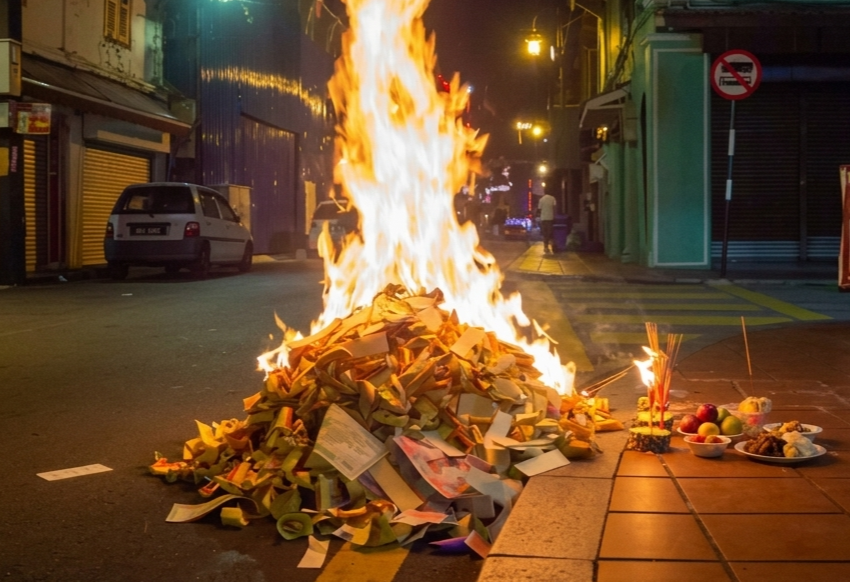
One of the most visible and universally practised rituals is the burning of joss paper, also known as ghost money or hell banknotes, along with paper replicas of material goods. The logic behind this practice is rooted in the belief that objects burned in the earthly world are received in the spirit world.
Paper offerings today have evolved far beyond simple banknotes. You can find paper replicas of luxury cars, smartphones, designer handbags, landed houses, and even paper domestic helpers and bodyguards. The idea is that the deceased should be comfortable and well-provided for in the afterlife.
These offerings are typically burned at designated roadside spots in the evenings, often in front of the family home or business, inside a large metal bin or on a patch of open ground. It is considered important not to stand directly over the smoke or to kick and disturb offerings that have been placed out for spirits.
Food Offerings and Roadside Altars
Throughout Ghost Month, it is common to see small altars set up at the edges of pavements, outside shophouses, or in front of homes in residential neighbourhoods. These altars typically hold offerings of food such as fruits, biscuits, rice, and cooked dishes along with incense sticks and red candles.
For many Malaysian Chinese families, preparing offerings is an act of love and duty. The specific dishes offered may reflect the preferences of a deceased family member.
Wayang and Getai Performances
One of the most distinctive expressions of the Hungry Ghost Festival in Malaysia is the staging of live performances for the spirits. In many parts of the country, particularly in Penang, Ipoh, Klang, and older Chinese settlements, Chinese opera (wayang) troupes are engaged by community associations or clan societies to perform for several nights during Ghost Month.
These performances are technically staged for the spirits, not the living audience, which is why the front row of seats is traditionally left empty and reserved for the unseen guests. Despite this, wayang performances draw large crowds of curious onlookers and community members who grew up with the tradition.
In more urban areas, getai (歌台), a modern form of live variety entertainment featuring Mandarin and dialect pop songs, comedy sketches, and dance, has become an increasingly common alternative, especially in the Klang Valley. Some getai performances run across multiple nights and feature well-known Malaysian Chinese entertainers.
Releasing Water Lanterns
In Penang especially, the practice of releasing floating paper lanterns on rivers or the sea during Ghost Month remains alive in certain communities. These lanterns are lit and set afloat to guide wandering spirits, helping them find their way and eventually return to the underworld at the end of the month. The sight of dozens of glowing lanterns drifting on the water at night is one of the most visually striking expressions of the festival.
Ghost Month Taboos Observed in Malaysia
For many Malaysians, Ghost Month comes with a well-known set of precautions and taboos passed down through families and communities. Whether you observe them strictly or more loosely, understanding them sheds light on how deeply the festival shapes everyday behaviour during this period.
The following are among the most commonly observed taboos in Malaysia:
- Do not swim at night. Bodies of water are believed to be favoured gathering spots for wandering spirits. Swimming after dark is considered risky, as spirits may pull the living under.
- Avoid moving house or starting a new business. The seventh month is generally considered inauspicious for major life changes. Beginning a new venture or relocating during Ghost Month is thought to invite bad luck or spiritual interference.
- Do not get married or hold major celebrations. Weddings and large gatherings are traditionally avoided during Ghost Month. Many Malaysian Chinese couples deliberately choose wedding dates outside of the seventh lunar month, and event venues often see fewer bookings during this period.
- Do not pick up money found on the street. Coins or notes on the ground during Ghost Month may be offerings left for spirits. Picking them up is believed to bring misfortune.
- Avoid stepping on or disturbing roadside offerings. If you see incense, food, or paper offerings on the pavement, walk around them. Kicking over an altar or even accidentally is considered deeply disrespectful and potentially unlucky.
- Do not stay out too late, especially children. Elders often caution young children and teenagers against being outdoors late at night during Ghost Month, as spirits are believed to be more active after dark.
- Avoid hanging your laundry outside overnight. Spirits may try on your clothes, and wearing garments that have been ‘worn’ by a spirit is considered unlucky. Many families bring in their laundry before nightfall throughout the month.
- Do not whistle at night. Whistling is said to attract wandering spirits or signal your awareness of their presence, something best avoided during a month when the spirit world is especially active.
The Cultural and Social Significance of the Festival in Malaysia
For many Malaysian Chinese families, the Hungry Ghost Festival is more than a religious observance. It is a time to remember loved ones, strengthen family bonds, and preserve traditions passed down through generations.
Beyond its spiritual significance, the festival also brings communities together through temple activities, clan associations, Chinese opera performances, and getai shows. These shared traditions help keep Chinese cultural heritage alive while fostering a sense of belonging.
In Malaysia’s multicultural society, the festival has become a familiar part of the nation’s cultural landscape. While customs may evolve over time, the values of remembrance, filial piety, and respect for the departed continue to remain at the heart of the celebration.
Conclusion
The Hungry Ghost Festival is far more than superstition or folklore. For many Malaysian Chinese families, it is a time to honour ancestors, remember loved ones, and uphold traditions that have been passed down for generations.
Beyond its spiritual significance, the festival reflects enduring values of filial piety, compassion, and respect for the departed. Understanding what the Ghost Festival celebrates and why it continues to endure is a meaningful step toward honouring the diverse cultural heritage that makes this nation so uniquely rich.